

Monitor Dissolved Oxygen in Winter: A Field Guide
Table of Contents
Last Updated: October 4, 2026
Why Dissolved Oxygen Monitoring Matters in Winter
Winter is when most fish die in ponds and aquaculture systems. It's not the cold itself, it's oxygen depletion under ice. When ice covers a pond, photosynthetic activity stops. Respiration from fish and decaying organic matter continues. The result is a dangerous drop in dissolved oxygen levels that can kill everything in the water.
This is why you need to monitor dissolved oxygen winter conditions so carefully. You need to know what's happening below the ice before it becomes a fish kill. At Cramer Machine Works LLC., we work with marinas and aquaculture operators, and we understand how monitoring prevents catastrophic losses.
Dissolved oxygen concentration is measured in milligrams per liter (mg/L) or as a percentage of oxygen saturation. Most fish need at least 5 mg/L to survive. Below that, stress increases. Below 3 mg/L, many species begin to die. Winter conditions make these thresholds critical because oxygen doesn't replenish naturally under ice.
The stakes are real. A single winter without proper monitoring can wipe out years of investment in a pond or aquaculture operation. Monitoring takes hours, not days. Prevention takes planning, not luck.
What Happens to Oxygen Levels Under Ice Cover
Ice cover creates a seal that stops oxygen from entering the water. Sunlight cannot penetrate thick ice, so photosynthesis halts completely. At the same time, fish and microorganisms continue to respire, consuming whatever oxygen remains in the water column.
This creates a dangerous cycle. Oxygen levels drop steadily throughout the winter. The longer the ice stays, the lower they go. In severe cases, the water becomes completely anoxic, meaning zero dissolved oxygen. When that happens, fish suffocate.
Water temperature also affects how much oxygen the water can hold. Cold water holds more dissolved oxygen than warm water. But that advantage disappears if the water becomes stagnant. Stagnant, cold water under ice loses oxygen faster than moving water because there's no circulation to mix oxygen-rich water from the top with depleted water at the bottom.
The thermocline, the layer where temperature changes rapidly, can trap oxygen depletion in certain zones. Fish congregate in deeper water during winter, where oxygen depletion is worst. This makes winter fish kills especially devastating.
Choosing the Right Dissolved Oxygen Meter for Aquaculture
You have two main paths: portable electronic meters or the Winkler titration method. Each has trade-offs in accuracy, speed, and cost.
Portable Electronic Meters vs. Winkler Titration
A portable electronic meter gives you a reading in seconds. You dip the probe into the water, wait for stabilization, and you have your DO concentration. No chemicals, no lab work, no waiting for results.
The Winkler titration method is older and more labor-intensive. You collect a water sample, add chemical reagents, and perform a titration to calculate oxygen concentration. It takes 15-20 minutes per sample and requires careful technique. But it's extremely accurate and doesn't depend on calibration drift over time.
When you monitor dissolved oxygen winter conditions, portable electronic meters dominate because you're sampling through ice holes in freezing conditions. You don't want to be outside longer than necessary. A meter that reads in 30 seconds beats a method that takes 20 minutes when the temperature is 10 degrees Fahrenheit.
The trade-off: portable meters need regular calibration and sensor maintenance. If your sensor drifts, your readings become unreliable. Winkler titration doesn't have that problem because you're measuring chemical reactions, not electronic signals.
DIY Accuracy vs. Professional-Grade Equipment
Many operators use consumer-grade dissolved oxygen meters because they're affordable and portable. These meters work. They give you usable data. But they drift faster than professional equipment, and they require more frequent recalibration.
Professional-grade meters cost more upfront but hold calibration longer and survive harsh field conditions better. They also have data logging features that let you record readings automatically over time. That continuous data is invaluable for detecting trends before oxygen crashes.
For small operations with just a couple of ponds, a quality consumer meter is often enough. For larger aquaculture systems where a fish kill means significant financial loss, professional equipment pays for itself by catching problems early.

Step-by-Step: How to Measure Dissolved Oxygen in Freezing Conditions
Pre-Winter Equipment Maintenance
Start before winter arrives. Test your meter's calibration in known solutions. Check the battery. Inspect the probe for cracks or corrosion. Replace any worn seals.
Store your meter indoors when not in use. Cold temperatures stress electronics and can damage sensors. Keep spare batteries on hand. Frozen fingers can't fumble for replacements.
If you use the Winkler titration method, verify all reagents are fresh. Old reagents give wrong results. Keep them in a temperature-controlled space.
Safe Sampling Through Ice
Never drill a hole and immediately sample. The drilling process disturbs sediment and releases gases. Wait 10-15 minutes for the water to stabilize.
Drill the hole at a location away from aeration equipment. You want a true reading of the water's actual oxygen concentration, not air being pumped in.
Use a long sampling tube or rod to reach water below the ice layer. The surface water under ice can have slightly different oxygen levels than deeper water. Sample at multiple depths if possible, surface, mid-depth, and near the bottom.
Wear gloves that let you grip the meter. Numb fingers drop equipment into freezing water. It happens. Prevent it.
Calibration and Data Recording
Calibrate your meter according to the manufacturer's instructions. Most meters calibrate to air saturation (100%) at atmospheric pressure. Some require a second-point calibration in a known solution.
Record your readings immediately. Write them down or log them electronically. Include the date, time, location, water depth, and air temperature. Temperature affects oxygen saturation, so that context matters.
Take readings at the same location and time each week. Consistent data reveals trends. One reading tells you the current situation. Weekly readings tell you whether oxygen is dropping fast or slowly.
Understanding Minimum Dissolved Oxygen for Fish Survival
Most fish species need at least 5 mg/L of dissolved oxygen to function normally. Below that, they experience stress. Their growth slows. They become susceptible to disease. They stop feeding.
At 3 mg/L, many species can't maintain normal activity. They gasp at the surface, trying to get oxygen directly from air. This behavior signals danger.
Below 2 mg/L, fish begin to die. The timeline depends on the species and how long they've been stressed. Some species are tougher than others. Carp tolerate lower oxygen than trout. But no fish survives long in anoxic water.
Benthic organisms, the creatures living in sediment at the bottom, die first. They have nowhere to escape. Their decomposition creates more organic matter that consumes oxygen. The cycle accelerates.
Winter Fish Kill Prevention Through Monitoring and Aeration
How Aeration Systems Maintain Oxygen in Winter
Aeration breaks the ice seal and introduces oxygen directly into the water. There are two main types: surface aerators and diffused air systems.
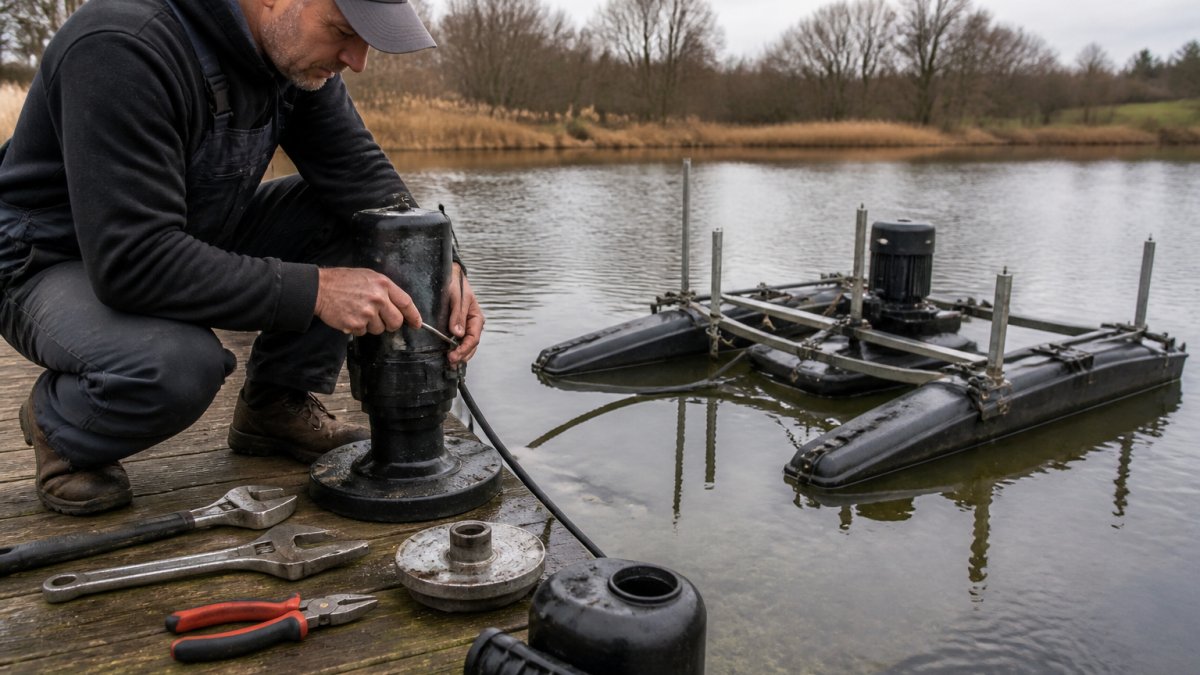
Surface aerators spray water into the air, where it absorbs oxygen. They also prevent ice formation in the area around them. A hole in the ice lets oxygen diffuse into the water below.
Diffused air systems pump air through tubing to diffusers at the bottom of the pond. Bubbles rise, creating circulation. The bubbles add oxygen, and the movement mixes oxygen-rich water throughout the pond.
For winter use, surface aerators are more practical because they prevent ice formation. You can place them at the dock or shore. Diffused systems work too, but they require maintaining a hole in ice where the air line exits.
Interpreting Data to Prevent Fish Kills
If your dissolved oxygen readings drop below 5 mg/L, increase aeration. Don't wait for 3 mg/L. By then, fish are already stressed.
If oxygen drops 1 mg/L per week, you're heading toward a crisis. Calculate how many weeks until you hit the danger zone. Plan your response now, not when oxygen is already critical.
If oxygen stays stable or rises week to week, your aeration is working. Keep doing what you're doing.
Watch for sudden drops. A 2 mg/L drop in one week signals a problem, maybe a power outage to your aerator, or a sudden algae bloom that consumed oxygen. Investigate immediately.
Temperature changes matter too. Warmer water holds less oxygen. If a warm spell hits during winter, oxygen levels drop even if nothing else changed. Increase aeration preemptively.
Common Mistakes and Safety Protocols for Winter Monitoring
A common mistake is sampling only once per season. One reading tells you nothing about trends. You need weekly data from November through March to understand what's really happening.
Another mistake is assuming ice thickness means oxygen is stable. Thick ice actually makes oxygen depletion worse because it seals the water more completely. Thin ice lets some diffusion happen. Neither scenario is good, but thick ice requires more aggressive monitoring.
Never drill ice holes near the edge. Ice is thinner at edges and can crack under your weight. Drill at least 10 feet from the shore.
Wear a life jacket if you're on a dock or boat. Ice is slippery. Falling into freezing water kills quickly.
Don't leave your meter outside in the cold. Bring it inside between samples. Electronics and batteries fail in extreme cold.
If you're using the Winkler titration method in the field, work quickly. Your hands will get cold. Numb fingers make precise measurements impossible.
Winter fish kills are preventable. You need three things: a way to measure dissolved oxygen, a schedule for taking measurements, and aeration equipment ready to deploy. Cramer Machine Works LLC. offers the Isvinder de-icer and Naiad surface aerator, equipment designed specifically for winter conditions in regions where ice forms. We understand how monitoring data can drive decisions about aeration timing and intensity.
Start monitoring now, before ice forms. Establish your baseline oxygen levels in fall. Then you'll know exactly what "normal" looks like for your pond or system. When winter arrives, you'll catch problems early and prevent losses. Get in touch with us to discuss which aeration solutions fit your operation's size and needs.
Frequently Asked Questions
What is the minimum dissolved oxygen level required for fish to survive winter?
Most fish species require at least 3-4 mg/L (parts per million) of dissolved oxygen to survive, though coldwater species like trout tolerate slightly lower levels. During winter, oxygen saturation drops due to ice cover blocking diffusion and reduced photosynthetic activity. Below 2 mg/L, fish stress increases dramatically, and levels below 1 mg/L typically result in winterkill. Monitoring your specific water body's oxygen concentration weekly ensures you catch dangerous declines before they become lethal.
How does ice cover affect dissolved oxygen levels in ponds and lakes?
Ice cover blocks atmospheric oxygen diffusion at the water surface and eliminates photosynthetic oxygen production from algae and plants. Simultaneously, respiration by fish, bacteria, and benthic organisms continues consuming oxygen. In stagnant water under thick ice, oxygen depletion accelerates rapidly. Water temperature also drops, which reduces oxygen solubility. This combination is why winterkill occurs most often in shallow ponds with heavy ice cover. Aeration systems can counteract this by introducing oxygen directly into the water column.
What equipment do I need to monitor dissolved oxygen in winter?
A portable electronic dissolved oxygen meter is the most practical choice for winter field sampling. You'll also need a sampling container, thermometer for water temperature readings, ice auger or hole-cutting tool, and data log sheets. Electronic meters measure DO concentration in mg/L or percent saturation; calibration kits maintain accuracy. For aquaculture operations, consider oxygen loggers that record continuous data. Winter-specific maintenance includes protecting sensors from frost damage and ensuring batteries function in cold temperatures.
How often should I check dissolved oxygen levels during winter?
Check dissolved oxygen levels at least weekly during the winter period, more frequently if ice thickness exceeds 12 inches or if you're managing an aquaculture system. Sample at multiple depths (surface, middle, bottom) to detect thermocline effects and benthic oxygen depletion. If levels drop below 4 mg/L, increase monitoring to every 2-3 days. Record water temperature alongside DO readings, as temperature directly affects oxygen saturation and fish metabolic rates. Consistent data helps predict dangerous trends before winterkill occurs.

Comments