

Pond Aeration for Fish Health: The 2026 Guide
Table of Contents
Last Updated: October 8, 2026
How Pond Aeration Protects Fish Health
Pond aeration for fish health works by maintaining dissolved oxygen at levels fish need to survive, especially during summer heat and winter ice cover, when natural oxygen production stops. At Cramer Machine Works, we build water-moving equipment for exactly these conditions.
Dissolved oxygen is the amount of oxygen gas dissolved in water and available to fish through their gills.

Dissolved Oxygen Targets and What Fish Need
Aeration systems are sized around oxygen targets, not guesswork. Bluegill and largemouth bass generally do best above 5 milligrams per liter; catfish tolerate slightly lower levels but still suffer below 3. When oxygen sits in the 2 to 4 range, fish survive but stop feeding and grow slowly.
That is why we tell pond owners to treat oxygen as the number that matters most. You can test it with a handheld dissolved oxygen meter, and the reading changes through the day.
Pond Aerator Types: Surface, Diffused, and Solar
Three pond aerator types cover nearly every situation: surface aerators, diffused air systems, and solar-powered units. Each moves oxygen into the water differently, and the right choice depends on pond depth, size, and whether you have grid power at the water's edge.
Aerator Type | How It Works | Best For | Power Need |
Surface | Throws water into the air | Shallow ponds, quick visual mixing | Electric or tractor PTO |
Diffused | Releases air at the pond floor | Deep ponds, whole-pond oxygen | Electric compressor |
Solar | Runs on panels during daylight | Remote ponds, no grid access | Solar array |
Surface Aeration
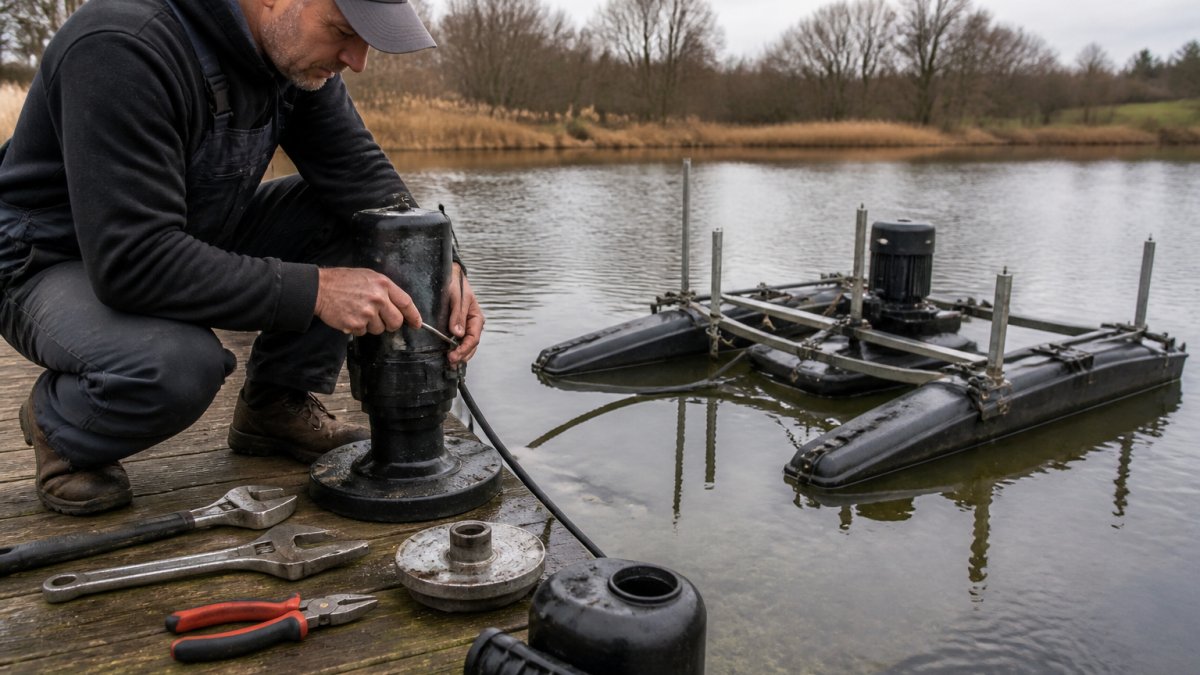
Surface aeration lifts water and sprays it into the air, where oxygen transfers at the droplets' surface. It is the simplest approach and works well in shallow ponds up to about 6 feet deep. Our Naiad surface aerator is built around this principle. The limitation is depth: surface units stir the top layer but do little for oxygen at the bottom of a deep pond.
Diffused Aeration
Diffused aeration pushes compressed air through lines to airstones on the pond floor, where bubbles rise and pull oxygen-poor bottom water to the surface. This is the most effective method for deep ponds because it treats the whole water column. The trade-off is infrastructure: you need a compressor on shore, weighted air lines, and a place to house the equipment. Our Sub Mix-Aire is a unique submersible mixer using the strengths of mechanical and diffused air aeration.
Solar Aeration
Solar aeration runs a compressor or surface unit from photovoltaic panels, which suits ponds far from an electrical outlet. The catch is obvious: output follows the sun. On cloudy days and at night, the system slows or stops, so solar works best as part of a broader plan rather than the only line of defense. For remote stock tanks and farm ponds, it beats no aeration at all.
Pro Tip Run diffused systems at night when plants stop producing oxygen and consumption peaks. If your system has a timer, shift the heaviest run hours to the pre-dawn window, when oxygen hits its daily low.
Pond Aerator Placement and Sizing for Your Waterbody
Pond aerator placement matters as much as the equipment itself. Put diffusers in the deepest part of the pond, where oxygen is lowest and bottom water is most stagnant.
Aquatic Control
For multiple diffusers, space them evenly along the pond's long axis rather than clustering them in one corner.
Sizing follows pond volume, not surface area alone. A pond that is 8 feet deep holds far more water than a 3-foot pond of the same footprint, and deep water is where oxygen problems concentrate.
Pond Aeration Hours Per Day: Seasonal Run Times
Pond aeration hours per day should change with the season, not stay fixed year-round. Summer demands the most run time because warm water holds less oxygen and algae blooms consume it overnight.
Season | Typical Run Time | Main Goal |
Summer | 8-12 hours, weighted to night | Prevent dawn oxygen crashes |
Fall | 4-6 hours | Manage turnover as layers mix |
Winter | 2-4 hours, or as needed | Keep an ice-free opening |
Spring | 4-6 hours | Rebuild oxygen as ice clears |
Many pond owners run aeration continuously in the hottest weeks and taper it as water cools. Watch your dissolved oxygen readings rather than the calendar. If pre-dawn oxygen holds above 5 milligrams per liter, you can back off; if it dips, add hours.
Watch Out Never start a diffused system at full power in a pond that has gone months without aeration. Bottom water can be loaded with hydrogen sulfide and near-zero oxygen, and mixing it suddenly can kill fish within a day. Run the system in short bursts over a week or two and let the pond adjust.
Winter Pond Aeration and Ice Management
Winter pond aeration keeps a hole open in the ice so toxic gases can escape and oxygen can enter.
The goal in winter is not vigorous mixing. It is maintaining an opening. Our Isvinder de-icer is designed for this job, clearing ice so waterfowl have open water and gas exchange continues.
Safety matters here. Never walk onto ice to adjust equipment near an open hole, and never assume ice is thick enough because it held last week. Open water from a de-icer weakens surrounding ice, and the edges are the most dangerous part.
Preventing Summer and Winter Fish Kills
Preventing fish kills comes down to staying ahead of oxygen crashes in both extremes of the year. Summer kills and winter kills have different causes but the same result: fish die in large numbers when oxygen runs out faster than it is replaced.
Summer Fish Kills
Summer kills usually strike in the hours before dawn after a stretch of hot, still, cloudy weather. Warm water holds less oxygen, algae blooms die off and decompose, and calm air stops surface mixing. The combination drives oxygen below the survival threshold just as fish are most stressed. Aeration run overnight through these conditions is the single most effective defense.
Winter Fish Kills
Winter kills happen under ice, where decomposition continues but photosynthesis nearly stops. Shallow, nutrient-rich ponds with heavy muck layers are the most vulnerable because rotting organic matter consumes oxygen all winter. Keeping an opening in the ice with a de-icer or diffused system lets gases vent and gives the pond a fighting chance.
Key Takeaway Fish kills are almost always an oxygen event, not a disease event. If fish die suddenly and in numbers, test dissolved oxygen first, then look at nutrient buildup and muck depth as the underlying cause.
Choosing and Sizing an Aeration System
Choosing an aeration system starts with the pond itself, not the catalog. Depth, volume, shape, stocking density, climate, and available power all change the answer, and two ponds of the same surface area can need very different systems.
Start With Volume, Not Surface Area
A pond that is 8 feet deep holds far more water than a 3-foot pond of the same footprint, and deep water is where oxygen problems concentrate. Estimate volume in acre-feet (surface acres times average depth in feet), then size the system to move that volume. As a starting rule, aim for at least one diffuser per acre of surface area in ponds up to 8 feet deep, then add units for depth beyond that. Irregular ponds with arms and inlets need extra diffusers because water does not mix that far on its own.
Factor In Stocking Density
A lightly stocked bass and bluegill pond can get by with less aeration than a heavily stocked catfish pond or a pond being fed daily. More fish, more feed, and more waste all raise oxygen demand, especially overnight. If you feed aggressively or stock near the upper end of what the pond supports, size up.
Factor In Climate and Season
Northern ponds face winter kill risk under ice and need a de-icer or a diffused system that can keep an opening. Southern ponds face longer, hotter summers with more frequent dawn crashes and need more summer run time. A pond that sees both extremes needs a system that can handle each.
Match the System to the Pond
Depth under 6 feet: a surface aerator handles mixing and oxygen transfer.
Depth over 6 feet: a diffused system reaches the bottom where oxygen is lowest.
No grid power: a solar unit covers daylight hours, paired with a backup plan.
Ice in winter: a de-icer or a surface unit that can run in cold water.
Large, irregular pond: multiple diffusers spaced along the long axis, not one unit in a corner.
Operating Costs and Energy Use
Run time drives cost more than equipment price. A diffused system typically uses less electricity per hour than a surface aerator of similar capacity because it moves a large volume of water with a compressor rather than a high-horsepower motor, but it runs longer to treat the whole column. Solar avoids grid cost but produces nothing at night, when oxygen is lowest.
Aeration Has Limits
Aeration does not remove nutrients or guarantee algae control. It buys oxygen and circulation, but it does not fix a pond overloaded with runoff, muck, or decaying vegetation. Reducing nutrient inputs, managing muck, and controlling algae all lower the oxygen demand your system has to meet. If your pond has chronic algae blooms, heavy muck, or repeated fish distress despite adequate aeration, a professional assessment of nutrient sources and sediment depth is the next step.
Key Takeaway Size for the worst week of the year, not the average. An oversized system running fewer hours beats an undersized one running constantly, and it gives you room to add fish or feed later without rebuilding.
Frequently Asked Questions
How many hours a day should you aerate a pond?
Run aeration continuously during summer, when warm water holds less dissolved oxygen and algae consume oxygen at night. In spring and fall, 12 to 16 hours daily is often enough. In winter, run surface units only during daylight hours to avoid supercooling the water. Every pond behaves differently, so monitor oxygen levels and adjust run times based on fish activity and water temperature.
Can fish survive in a pond without aeration?
Fish can survive in a pond without aeration if the pond is deep, wind-exposed, and has low nutrient levels. Problems appear when organic matter builds up, algae blooms die off, or ice seals the surface. In those conditions, dissolved oxygen drops fast and fish kills follow. Aeration for fish health is most valuable in ponds with heavy nutrient loads, dense algae, or limited natural circulation.
What type of pond aerator is best for fish?
Diffused aeration works well for most ponds because it releases oxygen near the pond floor, where decomposition consumes it fastest. Surface aerators are simpler to install and effective in shallow ponds. Solar units suit remote ponds without power. The right pond aerator type depends on depth, size, and whether you need year-round operation, so match the unit to your pond rather than the other way around.
Where should you place a pond aerator?
Place diffused aeration lines in the deepest part of the pond, where oxygen depletion is worst. Set surface aerators away from shorelines and shallow weed beds so they circulate open water. Avoid placing units directly over fish spawning areas. Pond aerator placement matters most in irregular ponds, where a single unit may leave dead zones that need a second diffuser or a repositioned line.
Should you aerate a pond in winter?
Winter pond aeration keeps a hole open in the ice so harmful gases escape and oxygen enters. Run surface units during daylight hours only and keep them near the surface, because pushing cold air into deep water can chill fish. In regions where ice formation occurs during winter, a de-icer can keep ice clear for waterfowl and protect fish through freeze events.
Can you put too much aeration in a pond?
Yes. Oversized systems can churn up sediment, cloud the water, and disturb fish. Sudden changes in oxygen and temperature stress fish more than steady, moderate aeration. Size the system to your pond volume and depth, and start new systems gradually over several days so fish adjust to the new conditions.
How does pond aeration improve fish health?
Aeration raises dissolved oxygen, which fish need for respiration, digestion, and immune function. It also circulates water, breaks up thermal stratification, and supports beneficial bacteria that break down organic matter. The result is cleaner water, fewer algae blooms, and a healthy habitat where fish grow faster and handle summer heat and winter cold with fewer losses.

Comments