

Metal Fabrication Ordering, Our Advice
Table of Contents
How Ordering Custom Metal Fabrication Online Works
What to Have Ready Before You Request a Quote
How to Prepare CAD Files for Metal Fabrication
DXF vs. STEP vs. Native CAD: Which Format to Send
File Optimization: The Settings That Cut Cost and Prevent Rejection
What to Send Alongside the File
What Drives the Number: Material, Thickness, and Volume
Choosing Materials and Finishes for Custom Metal Fabrication
Prototypes vs. Production Runs: Planning Your Order
Common Mistakes to Avoid When Ordering Online
Frequently Asked Questions
Last Updated: September 29, 2026
How Ordering Custom Metal Fabrication Online Works
Ordering custom metal fabrication online means sending a fabricator your design files, getting a quote, and receiving finished parts without visiting the shop floor. At Cramer Machine Works LLC., we have handled everything from one-off plasma-cut signs to small production runs since 2020, and the projects that go smoothly all share one thing: the customer arrived prepared.
What to Have Ready Before You Request a Quote
Before contacting any fabrication shop, gather four things:
A finished CAD file in a format the shop accepts
The material and thickness you want
Quantity, including whether you need a prototype first
Your deadline and any finish requirements
Missing any one slows the quote down, turning the process into constant emailing back and forth instead of anything useful getting done.
How to Prepare CAD Files for Metal Fabrication
A CAD file is the set of instructions a fabricator's machines follow, so errors in the file become errors in the part. Most delays trace back to file problems, not machine problems. Make sure drawing is to scale and without any issues, as fixing could lead to an increase in price for you depending on how much needs to be done.
DXF vs. STEP vs. Native CAD: Which Format to Send
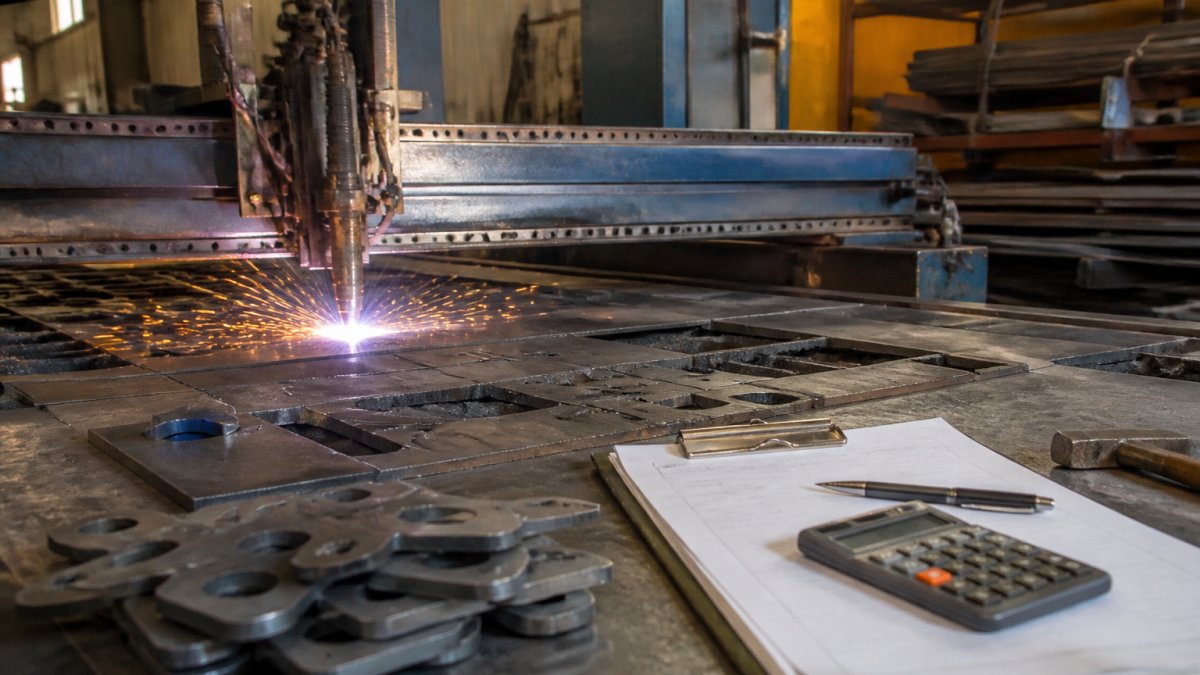
DXF is a 2D exchange format used for plasma and laser cutting, for example here at Cramer Machine Works we have a CNC 2 axis plasma table. So make sure if you need more complex parts cut out, that they can be assembled from flat pieces fabricated together. DO NOT send us a STEP file, as we do not have the equipment to cut it.
File Optimization: The Settings That Cut Cost and Prevent Rejection
Most guides stop at "send a DXF or STEP," but what you export determines whether the quote comes back accurately to actual cost. Work through this list before you upload:
Units and scale. Confirm the file is exported in imperial or metric, do not have a mix of both as this will lead to having to redraw the file. A DXF drawn in millimeters but read as inches produces a part far too large.
Text as geometry. Engraved or cut-through text must be converted to outlines (sometimes called "explode" or "convert to paths"). Live text objects, if the file has them, frequently fail to import correctly, or could have the wrong font.
Duplicate and overlapping entities. Two lines drawn on top of each other cut twice, double the cut length on that segment, and can confuse nesting software. Make sure to check and delete any duplicate lines, even on some of our drawings we’ve had accidental duplicates and it can be a real pain to find and fix.
Open contours. A profile with a gap will not cut as a closed part. Depending on the gap it can be a major issue, though if it’s small enough the kerf bridges the gap.
Kerf awareness. When making a drawing, please be aware that the part may cut slightly smaller than with the actual drawing, due to the kerf from the plasma cutting process. Generally if you are sending in a drawing to us for example you do not have to worry about that as our cutting program has offset options, though for thicker material you may have to factor in the kerf. All of this depends on how precise you want your part.
Bend-line notation. If the part needs to be bent and we are doing that as well it is best to include instructions on which way each bend needs to go, many cad programs have a text option that does not show up on the actual drawing when converted to an NGC if you want to include it in the DXF itself.
Pro Tip Run a contour check before exporting. Open paths and duplicate lines are the two most common reasons a DXF can not properly translate to an actual cutting file, and checking beforehand can prevent any potential fee increases.
What to Send Alongside the File
A file alone only goes so far, make sure to send accurate instructions on what material is needed, how the part needs to be bent or welded together. Material and thickness is also important so we can get the right material and keep both of us from having our time and money wasted.
What Drives the Number: Material, Thickness, and Volume
Cost Factor | Why It Matters | How to Reduce It |
Material type | Stainless and aluminum cost more than carbon steel | Use carbon steel where corrosion is not a concern |
Material thickness | Thicker plate cuts slower and can lead to higher consumable wear | Specify the thinnest gauge that the part can reliably use without failure. |
Cut Complexity | More intricate drawings and parts means that the plasma table is running longer, and consuming more consumables which can increase your cost. | Simplify profiles and reduce decorative cuts if project allows it and if you truly want that. |
Quantity | Setup cost spreads across more parts | Order in large batches, this will lead to lower per part cost. |
Finish | Depending on what you want the finish to be we will need to order either more paint or powder on top of preparing the surface for it. | There is no real way to reduce it unless you have no interest in what the part looks like. Or if you want to do it yourself. |
Choosing Materials and Finishes for Custom Metal Fabrication
Material choice comes down to three questions: what loads the part carries, what environment it lives in, and what it looks like finished. Stainless steel resists corrosion and suits food, marine, and outdoor use. Aluminum is light and rust-resistant, good for signs and brackets. Carbon steel is the workhorse for structural and industrial parts where cost matters most.
Prototypes vs. Production Runs: Planning Your Order
Prototyping is producing one or a small number of parts to verify if the thing even works and if you need to adjust anyhing before committing to a larger volume. Production runs follow once the drawing and part are within whatever tolerance you desire. If you are confident in the part, say we’re copying and making what already existed. Or simply moved to us as a new manufacturer in which case a sample is not necessarily needed.
Key Takeaway Don’t skimp out on the prototype if you can help it, unless you know the part 100% works at least get a single sample before committing your money and our time to something that doesn’t work.
Common Mistakes to Avoid When Ordering Online
These mistakes account for most delayed and rejected orders, and each is preventable at the design stage.
Sending a PDF instead of a DXF.
Specifying a needlessly tight tolerance, if the job doesn’t need a 1/1000th tolerance for a hole do not ask for it, this can increase your cost.
Forgetting to state material, thickness, and desired finish. We’ve had a lot of jobs where people ask for a part and never actually specify the specifics, it just wastes both our time.
Frequently Asked Questions
How do I get a quote for custom metal fabrication online?
Most shops ask for three things: your CAD file (DXF or STEP), the material and thickness you want, and the quantity. Include any tolerances, finish, and hardware needs in the notes. Cramer Machine Works accepts quote requests through email and can also handle plasma-cut signs and one-off repair parts, not just production runs.
What file formats are required for online metal fabrication?
DXF is the standard for flat parts that will be laser cut or plasma cut. STEP works for 3D parts or assemblies. Avoid sending only a photo, while a photo can be useful to visualize how the part will look, it doesn't really offer any help unlike a drawing or dxf file. Always include the material thickness and accurate measurements.
Can I order small-scale production runs online?
Yes, and small runs are where online ordering works well. Quantities from one to a few hundred parts are common. Cramer Machine Works handles both machined and fabricated small-scale production and prototyping.
Get in Touch

Comments